



-

Selection of surface coating for stainless steel strip and its impact on subsequent processing steps
Stainless steel strip protective film (mainly PE protective film) is used to protect the surface of the board during storage, cutting, bending, and stamping processes, preventing scratches, indentations, and dust pollution. The selection of the film coating needs to match the surface type, processing technology, service environment, and peeling time of the stainless steel, referring to GB/T 20878
2026-09-14 -

What is the function of the stainless steel coil leveling (finishing) process
Flattening, also known as smoothing, is a small reduction rate rolling process after cold rolling and annealing. The reduction rate is usually only 0.5-3%, without changing the material thickness specifications. It relies on the rolling mill to lightly press the surface of the steel strip, and its main functions are as follows:
2026-09-08 -

How to solve the problem of large stamping rebound of stainless steel strip
1、 At the material level (source priority) 1. Reasonably reduce the hardness of materials For the same grade, the lower the hardness, the higher the elongation, and the smaller the rebound. Example: The original rebound of 301-3/4H was too large. If conditions permit, it can be changed to 301-1/2H, and the rebound will significantly decrease; The cost is a decrease in elasticity, an
2026-09-01 -

Why is stainless steel coil used in stamping hardware
Stamping hardware is the use of punching machines to punch, bend, and stretch sheet metal. Stainless steel coils are used as raw materials for coil materials, taking into account material properties, coil processing advantages, corrosion resistance, appearance, and mass production. They are widely used in various stamping hardware parts.
2026-08-24 -

What are the precautions for stainless steel strips in the storage process
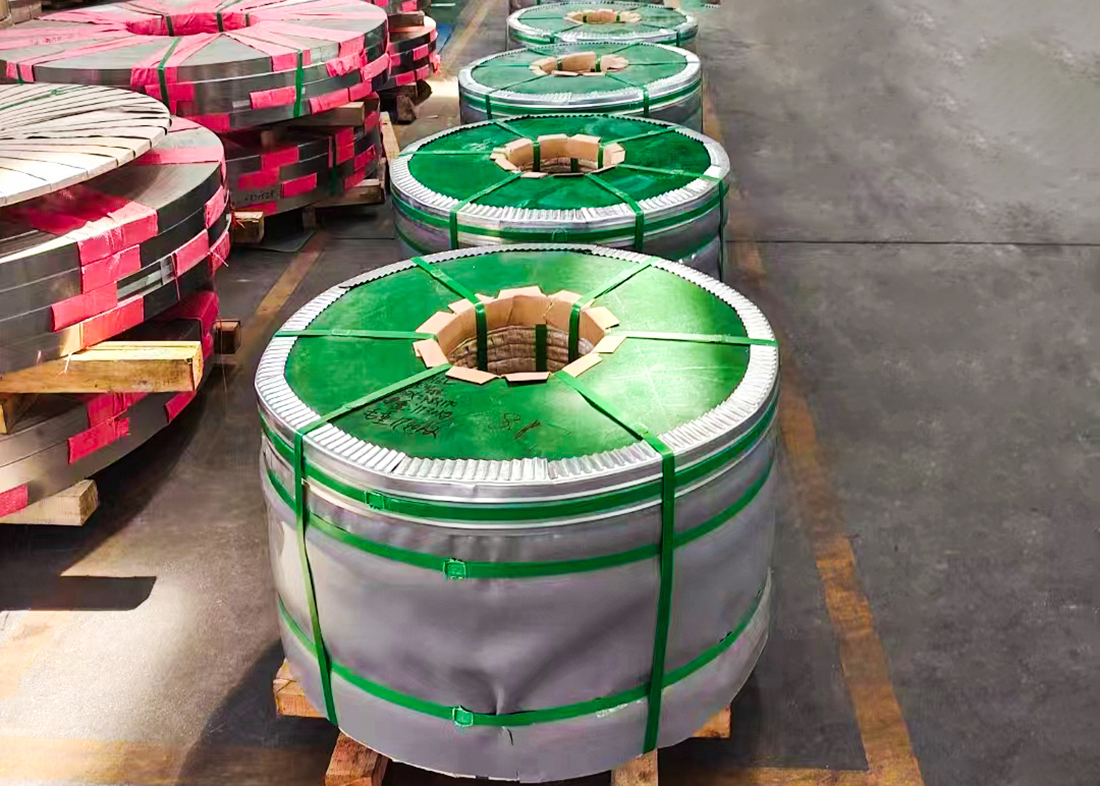
Core storage risks of stainless steel strips: iron ion contamination, rust, moisture pitting, surface scratches, coil deformation, mixed material errors, label loss. Once rust spots appear on austenitic stainless steel, they are difficult to remove.
2026-08-17 -

Why can't stainless steel coils be directly mixed with carbon steel materials when stored
Fundamental problem: Iron ion pollution (free iron pollution) causes induced corrosion on the surface of stainless steel, rather than the corrosion resistance failure of the stainless steel material itself.
2026-08-10 -

Which subsequent deep processing steps are suitable for the hot-rolled surface of stainless steel st
Stainless steel hot-rolled surface is not suitable for directly producing exposed finished products. Its advantages are thick thickness, low cost, and high substrate strength, making it suitable for working conditions that require subsequent cutting, forming, and precision machining.
2026-08-03 -

What is the production process of stainless steel coils
Divided into two categories: hot-rolled stainless steel coils and cold-rolled stainless steel coils (2B/BA, etc.) The mainstream route of steel mills: electric arc furnace smelting → AOD refining → continuous casting billet → hot rolling (producing hot-rolled coils); Hot rolled coils are used as raw materials and then enter the cold rolling process to produce cold-rolled stainless steel coi
2026-07-28 -

What equipment is stainless steel strip commonly used in the energy industry
Classify and organize according to new energy, traditional electricity, oil and gas petrochemicals, hydrogen energy, and nuclear power, and distinguish three types of uses: ultra-thin precision steel strips, structural bundling steel strips, and heat-resistant conveyor steel strips:
2026-07-22 -

What issues should be noted when rolling stainless steel coils
Stainless steel has high deformation resistance, is prone to work hardening, is easily oxidized at high temperatures, and is prone to cracking at the edges. It is divided into two parts: hot-rolled billet rolling and cold-rolled precision rolling. The raw materials, temperature, process parameters, equipment, lubrication, plate shape tension, surface protection, and later microstructure and proper
2026-07-13
- 09-142026
Selection of surface coating for stainless steel strip and its impact on subsequent processing steps
Stainless steel strip protective film (mainly PE protective film) is used to protect the surface of the board during storage, cutting, bending, and stamping processes, preventing scratches, indentations, and dust pollution. The selection of the film coating needs to match the surface type, processing technology, service environment, and peeling time of the stainless steel, referring to GB/T 20878
- 09-082026
What is the function of the stainless steel coil leveling (finishing) process
Flattening, also known as smoothing, is a small reduction rate rolling process after cold rolling and annealing. The reduction rate is usually only 0.5-3%, without changing the material thickness specifications. It relies on the rolling mill to lightly press the surface of the steel strip, and its main functions are as follows:
- 09-012026
How to solve the problem of large stamping rebound of stainless steel strip
1、 At the material level (source priority) 1. Reasonably reduce the hardness of materials For the same grade, the lower the hardness, the higher the elongation, and the smaller the rebound. Example: The original rebound of 301-3/4H was too large. If conditions permit, it can be changed to 301-1/2H, and the rebound will significantly decrease; The cost is a decrease in elasticity, an
- 08-242026
Why is stainless steel coil used in stamping hardware
Stamping hardware is the use of punching machines to punch, bend, and stretch sheet metal. Stainless steel coils are used as raw materials for coil materials, taking into account material properties, coil processing advantages, corrosion resistance, appearance, and mass production. They are widely used in various stamping hardware parts.
- 08-172026
What are the precautions for stainless steel strips in the storage process
Core storage risks of stainless steel strips: iron ion contamination, rust, moisture pitting, surface scratches, coil deformation, mixed material errors, label loss. Once rust spots appear on austenitic stainless steel, they are difficult to remove.
 Jiangsu Lichao New Material Technology Co., Ltd.
 WeChat ID:jinjiayi0512

 Add WeChat
 Contact us
 The phone