Welcome to Jiangsu Lichao New Material Technology Co., Ltd.




Why is stainless steel coil used in heavy equipment
source:www.cnlichao.net | Release time:2026年01月05日1. Strong corrosion resistance against harsh working conditions
Heavy equipment often operates in outdoor, humid, dusty, or acid-base medium environments (such as ore pulp corrosion in mines, salt spray erosion in ports, and muddy water immersion in construction machinery). The corrosion resistance of stainless steel coils can significantly extend equipment life:
Austenitic stainless steel coils (such as 304 and 316) contain chromium and nickel elements, forming a dense passivation film on the surface, which can resist corrosion from the atmosphere, fresh water, and mild acids and alkalis. Due to the addition of molybdenum, 316 stainless steel has stronger resistance to pitting and crevice corrosion, making it suitable for coastal or chlorine-containing conditions.
Ferritic stainless steel coils (such as 430) have low cost and excellent atmospheric corrosion resistance, making them suitable for structural components in dry environments.
Compared to ordinary carbon steel, stainless steel coils can prevent rusting, corrosion, and perforation of components, reduce maintenance frequency, and lower long-term usage costs.
II. High strength and wear resistance to meet heavy-duty requirements
The structural and protective components of heavy equipment must withstand immense impacts, compressions, and frictions. Stainless steel coils, through cold processing or alloy strengthening, can exhibit excellent mechanical properties:
After cold rolling, hard stainless steel coils (such as 304-H) can achieve a tensile strength of over 650MPa and a yield strength of up to 300MPa. Their hardness far exceeds that of soft steel, enabling them to withstand the stress of heavy-load components (such as track guards for construction machinery and hopper liners for mining equipment).
Some stainless steel coils (such as duplex stainless steel 2205) possess both high strength and corrosion resistance, with a tensile strength of ≥800MPa. They can replace some high-strength alloy steels and be used for key structural components that withstand high pressure and heavy loads (such as flange reinforcement plates for wind turbine towers).
The stainless steel coil boasts a high degree of surface smoothness. After undergoing polishing or spray coating treatment, its wear resistance is further enhanced, enabling it to resist scouring and wear from sand, gravel, and other materials.
III. Process flexibility to adapt to complex molding
The components of heavy equipment come in various shapes (such as curved shields, irregular brackets, and corrugated plates). Stainless steel coils possess excellent plasticity and formability, meeting complex processing requirements:
Soft or semi-hard stainless steel coils have a high elongation rate (≥40%), and can be processed into shaped parts through processes such as bending, stamping, and rounding. After forming, they are resistant to cracking and deformation.
Stainless steel coils, especially 304 and 316 austenitic stainless steel, exhibit excellent welding performance. They can be welded to other steel or stainless steel components to form an integral structure, with the weld strength approaching that of the base material, making them suitable for modular assembly of large-scale equipment.
Stainless steel coils exhibit high dimensional accuracy (thickness tolerance ±0.01mm) and good surface flatness. After processing, they do not require additional polishing and can be directly used for appearance parts or precision components of equipment.
IV. Improving the durability and low-maintenance nature of equipment reliability
The operating environment for heavy equipment is complex, making maintenance challenging and costly. The durability of stainless steel coils can significantly reduce the operational and maintenance burden
Stainless steel coils are resistant to rust and corrosion, and the service life of their components can be 3-5 times longer than that of ordinary carbon steel, reducing the frequency of replacement (such as the protective plates on the crane arms of port cranes and the carriage boards of mine dump trucks).
The surface of stainless steel coils is resistant to fouling, making it easy to clean and maintain. This makes them particularly suitable for heavy-duty equipment in the food processing, pharmaceutical, and chemical industries, such as stainless steel mixing tanks and conveying equipment, as they meet hygienic requirements.
Stainless steel coils exhibit excellent resistance to high and low temperatures, maintaining stable mechanical properties within the range of -200℃ to 600℃. They are suitable for use in extreme cold and high temperature conditions, such as the protection of high-temperature components in polar engineering machinery and metallurgical equipment.
V. Meet the lightweight and environmental protection requirements of equipment
Modern heavy equipment, such as wind power equipment and new energy construction machinery, aims to reduce weight to enhance energy efficiency. Stainless steel coils can help achieve weight reduction while ensuring strength:
The specific strength (strength/density) of stainless steel coils is higher than that of ordinary carbon steel. By reducing the thickness, it is possible to achieve the same load-bearing capacity, thereby reducing the overall weight of the equipment and enhancing operational efficiency.
Stainless steel coils are 100% recyclable and reusable, meeting the requirements of environmental protection policies, and are particularly suitable for the green manufacturing needs of equipment.
The stainless steel coil boasts an aesthetically pleasing surface, which can be directly utilized without the need for painting, thereby reducing the use of paints and coatings and lowering VOCs emissions, aligning with environmental production standards.
prev:
What is the core anti rust element of stainless s…
next:
What are the raw materials for stainless steel st…
【Related articles】
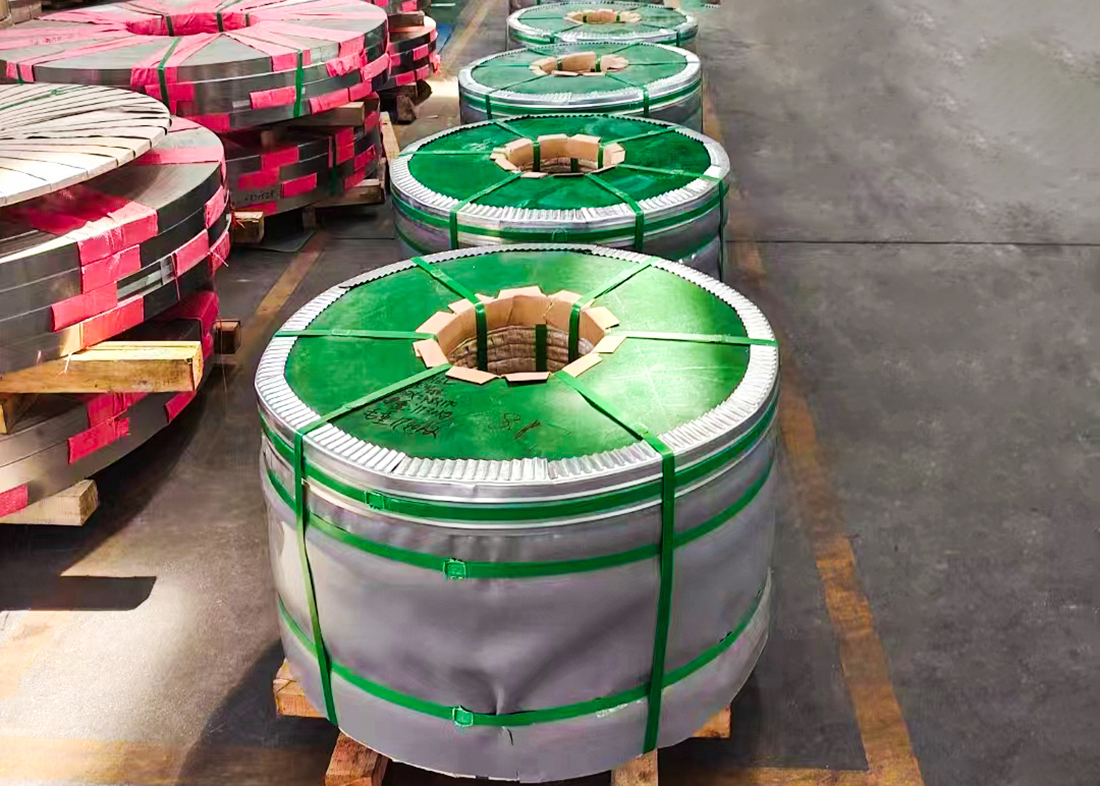
 Jiangsu Lichao New Material Technology Co., Ltd.
+
 WeChat ID:jinjiayi0512
WeChat ID:jinjiayi0512
 Add WeChat
 Contact us
 The phone